When a scientist announces a breakthrough a new gene therapy, a material that conducts electricity at room temperature, a vaccine developed in record time the story doesn't stay in one form. Journalists rewrite it. Press offices reframe it. Educators simplify it. Grant writers reshape it for funding panels. Each version needs to capture the same discovery while fitting a completely different audience and purpose. That's where advanced paraphrasing for scientific breakthrough narratives comes in, and doing it poorly can distort facts, mislead readers, or strip away the meaning that made the discovery significant in the first place.
Poor paraphrasing of scientific breakthroughs is not a minor writing problem. A Nature analysis found that oversimplified rewording of research findings has contributed to public misunderstanding of topics like CRISPR gene editing and climate modeling. When the narrative around a breakthrough gets mangled through careless rephrasing, the consequences reach beyond academia they shape public opinion, policy decisions, and even future funding.
What does "advanced paraphrasing" actually mean in the context of scientific narratives?
Basic paraphrasing swaps words for synonyms. Advanced paraphrasing restructures how the entire narrative is presented without changing the underlying science. It involves understanding the logical architecture of a scientific claim the problem, the method, the finding, the implication and rebuilding that architecture for a new context.
For example, take this original sentence from a research abstract:
"Our findings demonstrate that CRISPR-Cas9-mediated deletion of the CCR5 gene in human hematopoietic stem cells confers resistance to R5-tropic HIV-1 infection without detectable off-target effects."
A synonym-level paraphrase might produce something awkward and still jargon-heavy. An advanced paraphrase, depending on the target audience, would restructure the entire claim:
"Researchers used gene-editing tools to remove a protein that HIV uses to enter blood stem cells, and the edited cells resisted infection without showing unintended genetic changes."
Same science. Different architecture. Different audience. That's the difference between basic and advanced rewriting of scientific discovery narratives.
Why do people need to reword scientific breakthrough stories?
Scientific breakthroughs don't exist in a single communication channel. A single discovery might need to appear in:
- A peer-reviewed journal article
- A university press release
- A journalist's news story for a general audience
- A grant application for continued funding
- A textbook chapter for undergraduate students
- A policy brief for legislators
- A science blog or podcast script
Each of these contexts demands a different level of technical depth, a different tone, and a different narrative emphasis. The press release needs to hook non-specialist readers. The grant application needs to sound rigorous but forward-looking. The textbook needs pedagogical clarity. Paraphrasing is the tool that makes one discovery fit all these spaces.
If you're working on teaching sentence variation in science history contexts, this same principle applies the ability to restate scientific claims at different complexity levels is a core skill for students and science communicators alike.
What separates strong paraphrasing from plagiarism in scientific writing?
This is a question many researchers and science writers wrestle with, especially when covering the same breakthrough multiple times for different outlets or sections of a report. The line is clearer than most people think:
- Paraphrasing preserves the meaning but changes the structure, word choice, and often the emphasis. It may also add context or reframe the significance.
- Plagiarism keeps the original structure, swaps a few words, and presents the result as wholly original.
A practical test: if someone compared your version to the original and could see that you understood the concept well enough to explain it in a new way, you paraphrased properly. If they could see that you just rearranged the original author's sentence like a puzzle, you crossed the line.
In scientific writing, this matters even more because accuracy is non-negotiable. You can restructure the language freely, but you cannot change the finding. If a study found a "correlation," your paraphrase cannot call it a "causation." If the research used a "mouse model," you cannot drop that qualifier and imply human results.
How do you paraphrase a scientific breakthrough without losing accuracy?
Here's a step-by-step process that experienced science writers and editors use:
- Identify the core claim. Strip away methodology details, statistical specifics, and background context. What is the one thing the researchers actually found or built?
- Identify the scope and limitations. Was this done in cells, animals, or humans? Was it a small pilot study or a large trial? These qualifiers must survive the paraphrase.
- Determine your audience's knowledge level. This decides how much jargon to replace and how much explanation to add.
- Rewrite the logical structure, not just the words. If the original says "We used X method to show Y result, suggesting Z implication," your paraphrase might lead with the implication: "Z may be possible, according to a team that demonstrated Y using X."
- Check for meaning drift. Compare your version against the original. Does every key claim, qualifier, and limitation still appear even if in different words?
Practicing with interactive rewording exercises focused on scientific discovery can help build this skill through repeated, low-stakes practice before you apply it to high-stakes writing.
What are the most common mistakes when rewording scientific narratives?
1. Losing the hedging language
Scientists carefully hedge their claims with words like "suggests," "may indicate," "is associated with," and "in this model." These aren't filler they're accuracy markers. When paraphrasing, writers often strip hedging language to make the text sound more confident or dramatic. This turns cautious findings into overblown claims.
2. Conflating the study with the phenomenon
A study that observed something in a controlled setting is different from something that happens in general. Paraphrases that drop phrases like "in this study" or "under these conditions" risk implying universality that the research doesn't support.
3. Swapping technical terms for imprecise everyday words
"Gene expression" is not the same as "genes working." "In vitro" is not the same as "in a lab experiment." Simplification is necessary for general audiences, but imprecise simplification misinforms. Good paraphrasing finds the simplest accurate wording, not the simplest possible wording.
4. Changing the narrative emphasis
If a study's primary finding was about drug resistance but it also mentioned a secondary observation about cell growth, a paraphrase that leads with cell growth misrepresents the research's priorities and conclusions.
5. Ignoring the timeline of discovery
Breakthroughs often build on decades of prior work. Paraphrases that make a single study sound like it appeared from nowhere strip away the scientific context that gives the finding its meaning.
What techniques work best for different types of scientific breakthroughs?
Not all breakthroughs are the same kind of story, and the paraphrasing approach should match the type of discovery:
Diagnostic breakthroughs (new tests, screening methods): Lead with the problem the new method solves. Restructure around patient impact rather than technical methodology. Keep specificity about sensitivity, specificity, and sample size.
Therapeutic breakthroughs (new drugs, treatments): Lead with the condition being treated and the outcome achieved. Always preserve the phase of clinical testing and the population studied. Avoid language that implies the treatment is available now if it isn't.
Fundamental discovery breakthroughs (new mechanisms, phenomena): These are the hardest to paraphrase for general audiences because there may not be a direct practical application yet. Focus on why the finding changes our understanding rather than what it does.
Technology breakthroughs (new instruments, methods): Describe what the technology enables that was previously impossible. Compare to existing alternatives. Keep performance claims tied to specific benchmarks.
How can you practice improving your scientific paraphrasing skills?
Like any writing skill, paraphrasing improves with deliberate practice. Here are methods that work:
- Side-by-side rewriting: Take a press release and the original abstract it was based on. Place them next to each other. Identify what was changed, what was dropped, and what was added. Then write your own version and compare all three.
- Audience switching: Take one research finding and write three versions one for a scientific peer, one for a science-literate journalist, and one for a high school student. This forces you to make active structural choices, not just word swaps.
- Fact-check your own paraphrases: After writing, go back and verify that every claim in your version can be traced to a specific claim in the original. If you can't find the source of a statement, you may have introduced unsupported information.
Working through varied examples across science history helps build flexibility. You can explore advanced paraphrasing methods applied to scientific discovery narratives to see how different approaches handle different types of breakthroughs.
Should you use AI tools for paraphrasing scientific content?
AI paraphrasing tools can speed up the initial draft, but they have significant limitations with scientific content. Current tools frequently:
- Drop or weaken hedging language, making claims sound more certain than they are
- Replace precise technical terms with approximate ones
- Introduce factual errors by making "reasonable-sounding" substitutions that change the meaning
- Flatten the logical hierarchy of an argument (treating primary and secondary findings as equal)
If you use AI tools as a starting point, treat the output as a rough draft that requires rigorous fact-checking against the original source. Never publish an AI-paraphrased version of a scientific claim without verifying every factual detail, every qualifier, and every causal versus correlational distinction.
Quick-Reference Checklist for Paraphrasing Scientific Breakthroughs
Before you publish any paraphrased version of a scientific breakthrough, run through this checklist:
- Core claim intact? Can you point to the original sentence that supports each main claim in your version?
- Scope preserved? Does your version still specify the model organism, sample size, study type, and population?
- Hedging language present? Are words like "suggests," "may," "in this study," and "under these conditions" still represented even if in different form?
- No meaning drift? Would the original authors read your version and recognize their findings accurately described?
- Audience-appropriate depth? Is the technical level right for your intended readers not dumbed down unnecessarily, not needlessly complex?
- Narrative emphasis correct? Does your version prioritize the same primary finding as the original, or have you accidentally spotlighted a secondary result?
- Source credited? Have you attributed the finding to the correct research group, institution, and publication?
Keep this list visible while you write. Scientific communication carries real weight a misparaphrased breakthrough can influence patient decisions, policy debates, and research funding. Getting it right is not optional; it's professional responsibility.
 How to Vary Sentence Structure When Describing Historical Scientific Discoveries
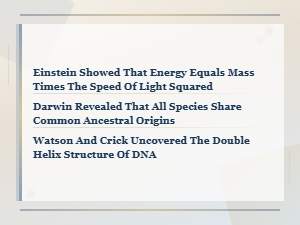 Examples of Rephrased Sentences for Major Scientific Discoveries
 Educational Resources for Teaching Sentence Variation in Science History
 Interactive Tools for Historical Event Sentence Rewording: Scientific Discovery Variations
 Rephrasing War and Conflict Sentences for Academic Essays
 Alternative Phrases for "war Broke Out" in Academic History Writing